Future of Commerce
Backgrounder: The AI Chip Bottleneck Is Moving Into Advanced Packaging
Leading-edge silicon still matters, but the ability to connect, cool, power, and package many components is becoming a system-level constraint.

01 · The problem
What changed
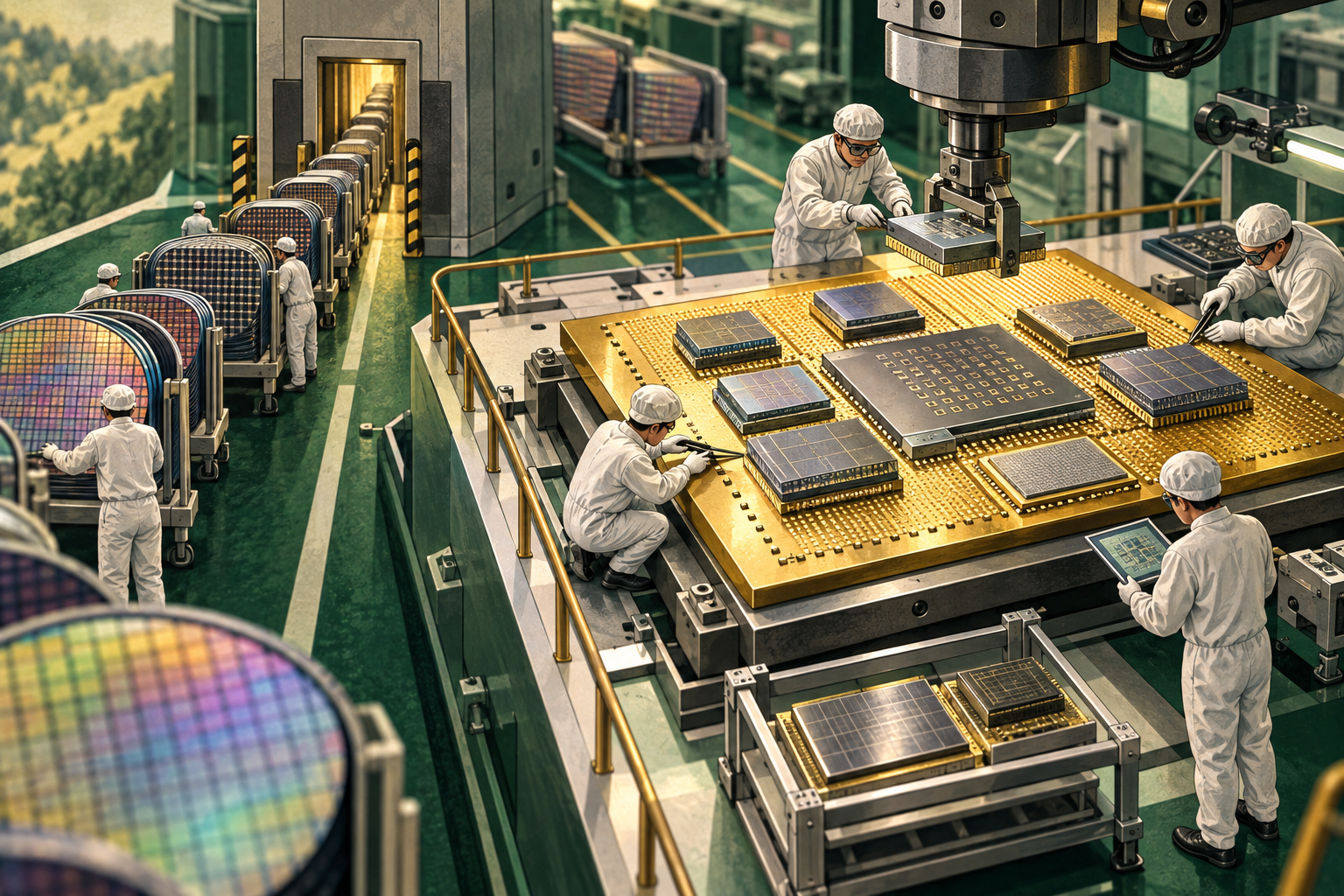
For years, semiconductor competition was summarized by the race to manufacture smaller transistors. That remains important, but an AI accelerator is not useful in isolation. High-performance systems must place compute close to high-bandwidth memory, connect multiple devices at speed, deliver enormous power, and remove the heat.
That makes advanced packaging—the technologies that assemble and interconnect multiple dies and components—a central part of capacity. NIST states that recent advances in artificial intelligence would not be possible without advanced packaging and warns that semiconductor investment cannot succeed without parallel investment in packaging [1].
02 · The stakes
Why it matters
A buyer can see a chip announced months before a complete system is readily obtainable. The bottleneck may sit in packaging capacity, memory, networking, substrates, power equipment, cooling, or data-center construction. Treating the processor as the entire supply chain obscures both schedule risk and total cost.
This also complicates competition. A company may design a capable accelerator and still depend on scarce packaging processes and memory supply. Cloud providers and large customers with multiyear capacity commitments can gain an advantage that a benchmark chart does not reveal.
03 · The evidence
What the record shows
TSMC's 2025 annual report describes advanced packaging and 3D stacking as enabling technologies for energy-efficient high-performance computing and outlines continued expansion of its CoWoS platform for AI and HPC demand [2]. The emphasis matters: the foundry is presenting packaging as part of the performance roadmap, not as a final commodity step.
NVIDIA's 2026 annual report provides the customer-side warning. It says some manufacturing and component lead times can extend beyond twelve months and identifies supply constraints across data-center components as a factor that can affect revenue and product availability [3].
Together, the disclosures point to a system bottleneck. More wafer output helps only if the rest of the stack can be assembled, tested, powered, cooled, and delivered.
04 · The response
What to do
Infrastructure buyers should map the full bill of materials and the critical path behind a promised deployment date. Ask which components are allocated, which are merely forecast, who owns integration, and what happens when one part slips.
Software teams should design for constrained capacity as well. Model compression, batching, caching, workload scheduling, and the ability to use more than one accelerator class can turn supply-chain flexibility into a product advantage. The right architecture is not always the one that assumes unlimited access to the fastest device.
05 · The bigger signal
What to watch next
The AI hardware race is becoming an integration race. Advantage will accrue not only to the company with the best die, but also to organizations that coordinate foundry capacity, packaging, memory, networking, power, cooling, system software, and customer deployment.
Watch packaging-capacity announcements alongside accelerator launches. Also watch lead times, memory availability, power-delivery projects, and liquid-cooling adoption. Those less glamorous signals can reveal deployable AI capacity sooner than a headline performance claim.
Action desk
Your next moves
- 01
Add packaging, memory, networking, power, and cooling to every AI-infrastructure capacity review.
Time: 45 minutes
- 02
Require suppliers to distinguish allocated capacity from forecasts and nonbinding delivery targets.
Time: 2 hours
- 03
Benchmark one lower-cost or more available accelerator path for a noncritical workload.
Time: 1 day
Evidence
Sources
3 cited
- [1]National Advanced Packaging Manufacturing Program
National Institute of Standards and Technology · Primary source
- [2]TSMC 2025 Annual Report
Taiwan Semiconductor Manufacturing Company · Primary source
- [3]NVIDIA Corporation 2026 Annual Report
U.S. Securities and Exchange Commission — Press Releases · Primary source
Pass the signal
Know someone this affects?
Get the next briefing
One useful signal, delivered daily.
Keep up with platform changes, earnings pressure, and practical next moves.